
Pool fence installation in South Florida
Aluminum picket and removable mesh pool fencing with self-closing, self-latching gates — designed around Florida’s residential pool barrier law and your building department’s rules.
What Florida’s pool barrier law requires
Florida’s Residential Swimming Pool Safety Act sets the baseline for residential pool barriers. Under §515.29:
- The barrier must be at least 4 feet high on the outside.
- It can’t have gaps, openings, indentations, protrusions or structural parts that would let a young child crawl under, squeeze through or climb over.
- It goes around the perimeter of the pool. A yard fence can serve as part of the barrier if it sits on the pool perimeter and meets the requirements.
- It must be placed far enough from the water’s edge that a child who gets through can’t immediately fall in.
- Gates must open outward, away from the pool, self-close and self-latch, with the release placed where a young child can’t reach it.
- Nothing permanent — equipment, structures or similar objects — can sit where it helps someone climb over.
- A wall of the house can be part of the barrier only if it has no door or window giving direct access to the pool.
Sources: Florida Statutes §515.29 · Village of Wellington — House Bill 803 permit exemption
Pool fence options
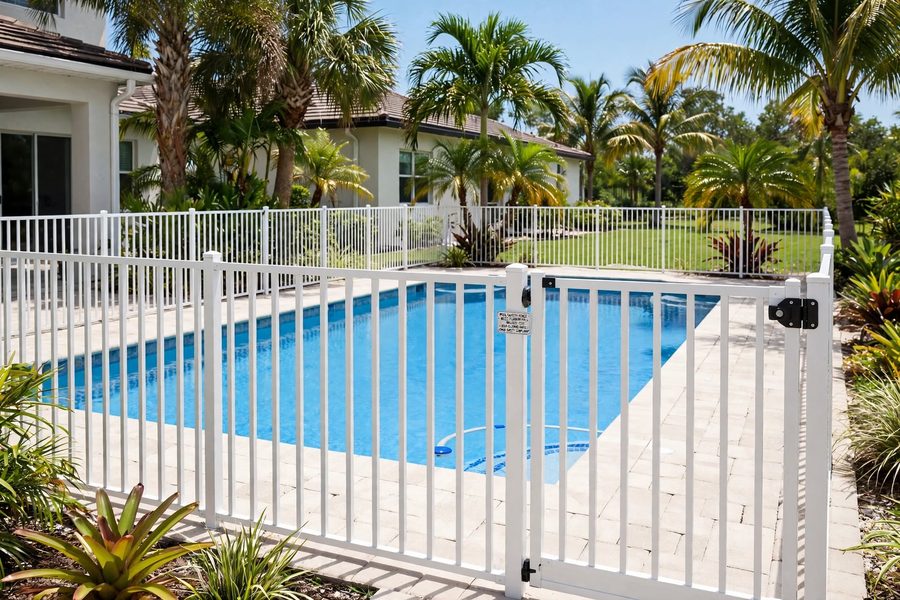
- Aluminum picket — permanent, open and available in black, bronze or white; can match your perimeter fence
- Removable mesh — a see-through barrier that can be taken down when adults are using the pool
- Self-closing, self-latching gates — the part inspectors check most closely
- Gate hardware repair — hinges and latches that no longer close reliably (see gate repair)
When owners call us
- New pool — the barrier has to be in place and pass inspection
- Selling or buying a home — if an inspection flags the pool barrier, text us your deadline and we’ll tell you honestly whether it’s realistic
- Storm damage — if the barrier is down, keep children and pets away from the pool and secure the area until it’s repaired
- Adding a pool fence inside an existing yard fence — common for families with young children
What affects the price of a pool fence
- Perimeter length and how many gates you need
- Aluminum vs. removable mesh
- Deck, pavers or soil — what the posts go into
- Matching an existing fence or HOA style
- Permit requirements
You get a written, itemized proposal after a free on-site visit.
Warranty
FenceFox installations come with a 1-year workmanship warranty. Manufacturer warranties vary by product, and your written proposal lists the exact coverage. The workmanship warranty doesn’t cover storm or hurricane damage, vehicle impact, deliberate damage, or damage caused by later modifications or landscaping work.
Frequently asked questions
Florida law requires the barrier to be at least 4 feet high on the outside. Your local code may add further requirements, which we check for your property.
Outward, away from the pool. It must also be self-closing and self-latching, with the release out of a young child’s reach.
Removable mesh keeps the view and can come down when adults are swimming; aluminum is permanent, low-maintenance and can match your yard fence. Both can meet the barrier rules when installed correctly.
It can, if it sits on the pool’s perimeter and meets all the barrier requirements — including the gates.
Pool barriers generally require a permit and inspection, and they aren’t part of the HB 803 small-project exemption. We handle the permit.
Related services & areas
Need a pool barrier that passes inspection?
Text us the city, a photo of the pool area and any deadline you’re working against.